
Applying for a job used to mean something. You'd actually read the job description, write a tailored cover letter, maybe even follow up with a call. The process itself filtered out the noise.
That friction is gone. Bots can fire off 500 applications in the time it takes you to review one resume.
But not all AI use is sketchy. Plenty of genuine candidates are using ChatGPT to clean up their writing before hitting ‘apply’. The problem is separating real applicants from the wave of spam hitting your ATS.
We dug into 3.2 million applications to find out which roles attract the most fake applicants and where hiring teams need to tighten their filters.
About the data
For this report, we looked at 3,261,897 applications submitted through Breezy over a six-month period (December 25, 2025 to May 26, 2026). Our data revealed clear patterns:
- 230,874 applications (7.08%) flagged as bot-automated
- 55,572 applications (1.70%) flagged as copy-pasted
- 207,363 applications (6.36%) with resumes created the same day they were submitted
These flags don't mean automatic rejection, but they can help hiring teams decide where to dig deeper. A same-day resume might be a rushed but genuine application. A bot-generated resume is probably spam.
Bot spam follows clear patterns. Certain roles, departments, and even job posting phrasing act as magnets for fake applications. Knowing where to expect the noise helps you protect your pipeline without burying genuine candidates.
Which roles attract the most spam?
If you're hiring for retail, operations, or warehouse roles, brace yourself. These positions get hammered with bot applications.
Entry-level jobs with standardized descriptions are easy targets for automated scripts. Bots can blast out hundreds of nearly identical applications without anyone having to actually read your job posting.
Department-level trends
The departments with the most openings see the most spam.
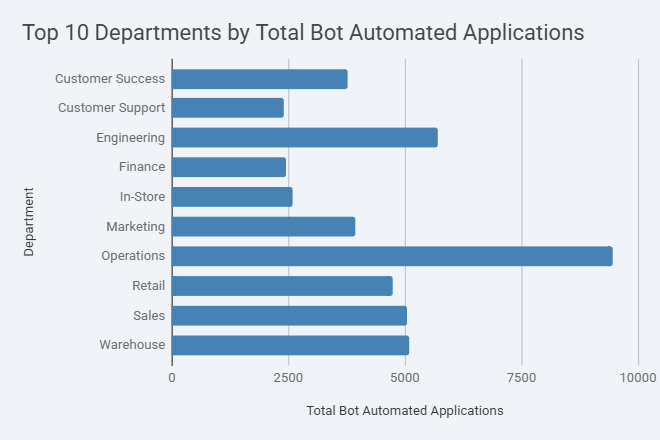
Operations took the biggest hit with 9,459 bot applications out of 154,397 total candidates. Engineering wasn't far behind with 5,710, followed by Warehouse (5,084) and Sales (5,052).
And it gets worse. Smaller, specialized departments are getting crushed by spam as a percentage of total applications. Repair saw 54.25%bot applications. Food Services hit 53.38%. Assembly reached 42.84%.
At 50% bot traffic, actual hiring work waits. You spend your day separating real from fake.
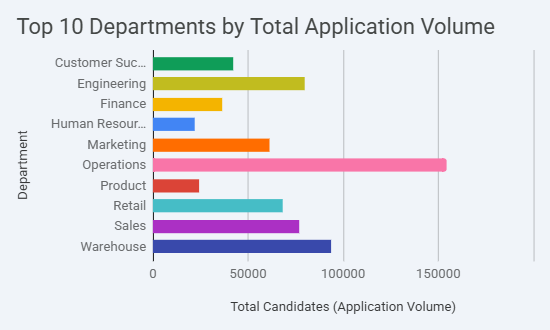
High-volume departments see the largest absolute numbers of automated spam. The Operations department leads with 9,459 bot-automated applications (out of 154,397 total candidates), followed closely by Engineering (5,710), Warehouse (5,084), and Sales (5,052).
Targeted job titles
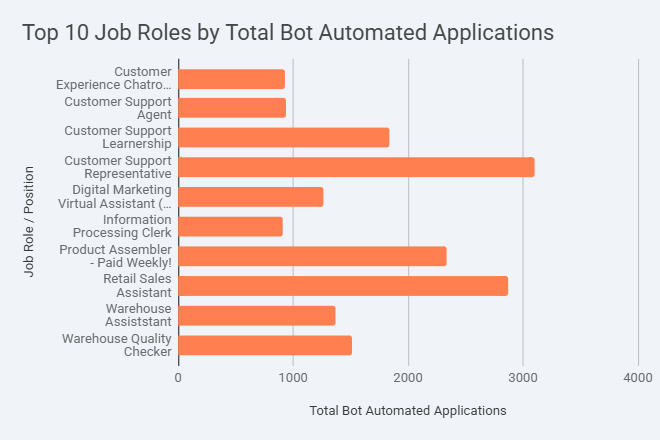
Bots love customer-facing roles with low barriers to entry. Customer Support Representative positions got hit with 3,099 bot applications. Retail Sales Assistant roles saw 2,871.
If your role has a simple application process and urgent hiring needs, you're a target.
Learnerships and entry-level programs
Even training programs aren't safe. Customer Support Learnership positions saw a 37.82% bot rate (1,839 fake applications out of 4,863 total).
Manufacturing and production
The manufacturing and production sector has a serious bot problem. Some roles in this category see spam rates spike above 40% — meaning nearly half the applications hitting your inbox are fake.
As a whole, this industry is hit with 16.13% bot spam (8,154 fake resumes out of 50,554 candidates), making it the most heavily spammed operational sector by percentage.
Operations and warehouse departments
Operations is dealing with 9,459 bot applications out of 154,397 total candidates. Warehouse has 5,084 bots out of 93,819 applicants. Retail is managing 4,733 fake applications out of 68,303 candidates.
When you need to fill shifts fast and maintain staffing levels, spending hours sorting through spam applications means real candidates are waiting longer to hear from you.
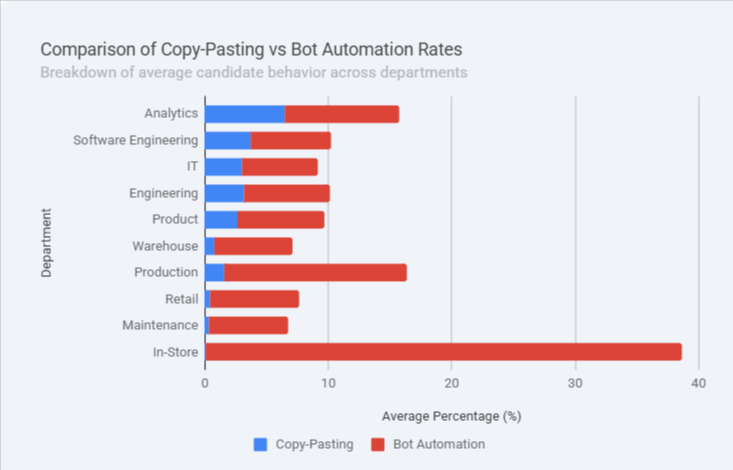
Technical and professional roles see more copy/pasting than bot automation
Operational roles get slammed by bots. Technical and professional fields? They've got a different problem: copy-pasted resumes.
IT (3.68%), Engineering (3.59%), and Product (3.03%) departments see the most copy-pasted resumes. Data Engineer positions hit 798 copy-pasted applications, while Data Analyst roles saw 384.
What's happening: candidates are copying large blocks of text — project descriptions, code keywords, technical frameworks — into their applications.
Some of this is probably legitimate (reusing descriptions from their own portfolios or past work). But high copy-paste rates make it harder to spot the candidates who genuinely have the experience versus those gaming the system.
- Cloud Operations: Leads with a 19.57% copy/paste rate compared to just a 5.43% bot automation rate.
- Financial Planning & Analysis (FP&A): Shows a massive gap, with 16.56% of resumes containing copy/pasted content versus only 3.97% generated by automated bots.
- Product Development & AI: Product Development sees a 16.23% copy/paste rate (vs. 9.34% bot), while AI records 14.79% copy/paste (vs. 5.74% bot).
- Implementation & Devops: Implementation roles experience 10.50% copy/paste (vs. 4.11% bot), and Devops roles see 9.13% copy/paste (vs. 6.90% bot).
Job titles with the highest copy/paste rates
Zoom in on specific roles and the problem gets worse:
- Healthcare EDI Developer: 70.51% copy/paste rate with 0% bots. You're seeing specialized compliance language and technical frameworks repeated word-for-word across applications.
- Sr. Data Modeler: 34.03% copy/paste versus 2.08% bots.
- SAP FICO Consultant: 38.55% copy/paste and 0% bots.
Why so much copy-pasting? These roles require specific certifications and technical knowledge, which means standardized language tends to show up across applications. Some candidates are probably reusing their own project descriptions. Others might be copying content to mass-apply.
Either way, when 70% of applications for a role contain copied text, it's tough to evaluate who actually has the skills.
Remote roles attract way more applicants (and way more spam)
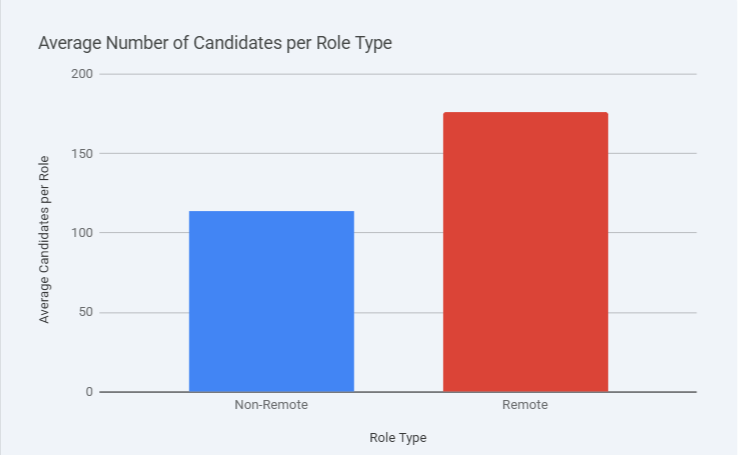
Post a remote role and get ready for the flood. Remote positions pull in an average of 176.1 candidates per role, compared to 113.9 for non-remote jobs. That's 55% more applications to sort through.
But here's the catch: those extra applicants aren't necessarily better quality.
Remote applications show different patterns
Candidates applying to remote roles behave differently. They're more likely to rush their applications and lean on automation:
- Same-day resumes: 10.36% of remote role applications use resumes created the same day, versus 6.08% for on-site. Some of these are genuine candidates moving fast. Others are spam.
- Resume builders: 11.08% of remote applicants use online resume builders, compared to 9.11% for non-remote roles.
- Bot applications: 8.58% of remote role applications are bot-generated, versus 7.46% for non-remote positions.
Remote roles bring volume, but you'll burn more time sorting through spam to find candidates worth interviewing.
How your job title wording affects spam rates
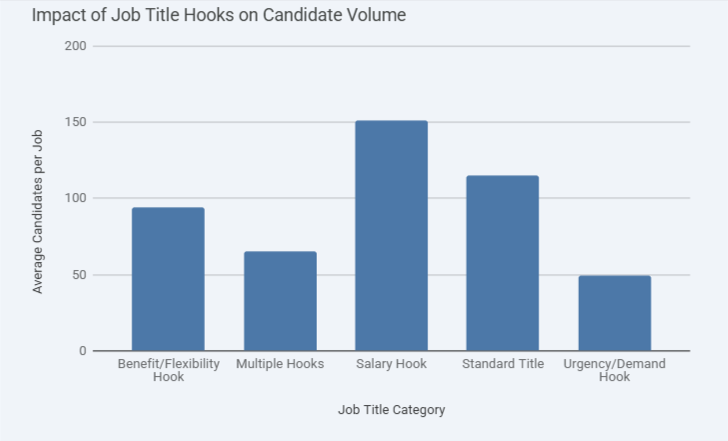
Want to double your application volume? Add "Paid Weekly!" or "No Experience Needed" to your job title. Want to quadruple your spam? Do the exact same thing.
Catchy phrasing works. But it works for bots just as well as it works for real candidates.
Multiple hooks = bot magnet
Stack multiple attention-grabbers in one job title and watch the bots arrive:
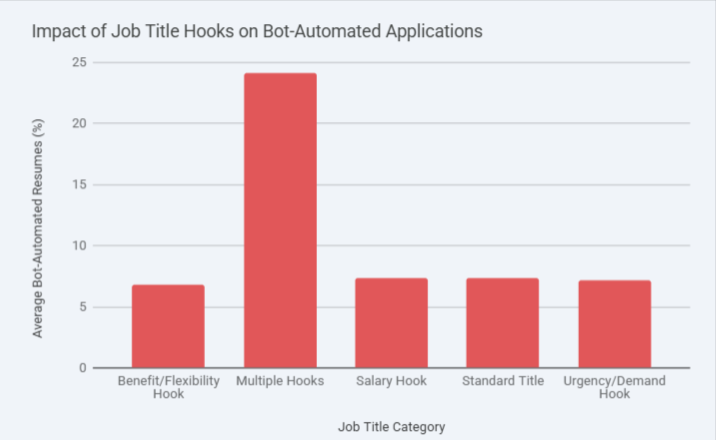
- Multiple hooks (urgency + pay frequency + exclamation marks): 24.16% bot applications
- Extreme examples: Paid Weekly! pulls in 67.1 candidates on average, but 41.37% are bots. No Experience Needed hits 16.52% bots.
- Authentic applications: Multi-hook titles see only 57.23% authentic resumes—the lowest across all categories.
Salary hooks bring volume without the spam
Here's what actually works: put the salary in your job title.
- Volume increase: Salary hooks (like $, OTE, or Earn) pull in 150.9 candidates per job versus 114.9 for standard titles. That's a 31% boost.
- Bot rate: Only 7.34% bot applications, basically the same as standard titles (7.36%).
- What works: Solar Appointment Setter (OTE $85K-$145K) and Entry Level Windows Sales Representative ($120k - $180k OTE)
Urgency hooks filter out casual applicants
Job titles with urgency language get fewer applicants, but better quality:
- Lower volume: Urgency hooks (like Urgently Hiring!, Wanted, or Needed) pull in only 49.6 candidates per job.
- Higher quality: But they hit 72.04% authentic resumes versus 67.49% for standard titles.
Serious job seekers respond to urgency. Bots and casual browsers don't.
What this means for your job postings
If you need volume and can handle screening, salary transparency works. If you want fewer but more serious applicants, use urgency language. And if you're drowning in spam? Check your job titles for multiple hooks and exclamation marks—you might be accidentally attracting bots.
What actually separates real candidates from spam
So here's where you are: 7% of your applications are bots. Manufacturing roles hit 40%+ spam. Technical positions see 70% copy-pasted text. And you're supposed to find your next hire somewhere in that mess.
The instinct is to lock everything down—add more hoops, more verification, more friction. But the answer isn't building a moat around your application process. It's getting smarter about what signals matter.
Green flags: what quality applications look like
Real candidates leave breadcrumbs that bots can't fake:
- Specific examples that reference your actual company, recent news, or specific challenges in your job description
- Proof of work like portfolio links, GitHub repos, project samples, or case studies that match the role requirements
- Thoughtful questionnaire responses that show they read beyond the job title
- Resume consistency where timing, locations, and progression make sense
- Reasonable application speed (not created and submitted in the same minute)
Red flags: patterns that suggest spam
Watch for these combinations, not individual signals:
- Resume created within hours of submission + generic cover letter + no portfolio links
- Copy-pasted job description language + same-day timing + resume builder
- Perfect keyword match + zero company research + bulk application timing
- Technical role claims + no verifiable work samples + high copy-paste percentage
No single flag means automatic rejection. But multiple flags together? That's when you dig deeper.
What to do with this data
If you're hiring for high-spam roles (operations, warehouse, manufacturing, retail):
- Add a 2-3 question qualifier at application time to filter mass-appliers
- Use same-day resume flags as a signal to verify, not auto-reject
- Consider urgency hooks in job titles to attract serious applicants over casual browsers
If you're hiring for technical roles (IT, engineering, data):
- Look for proof of work, not just keyword matches
- Flag high copy-paste rates for human review
- Ask for specific examples in questionnaires that can't be copy-pasted
If you're hiring remote roles:
- Expect 55% more applications and plan screening capacity accordingly
- Use tiered verification (light checks early, deeper validation for finalists)
- Build in authenticity checks before final-round interviews
For all roles:
- Use AI detection as decision support, not decision-maker
- Test your job titles—salary transparency brings volume without spam
- Review your screening process quarterly using actual bot/spam rate data
The real advantage: your own database
Here's what most teams miss: your best candidates might have already applied.
Past applicants and silver medalists who didn't quite fit a previous role make perfect matches for new openings. They're pre-screened, they know your company, and they've already shown genuine interest.
You can source from your existing database using exact criteria, automatically invite matches to apply, and review them before any communication goes out. Smaller volume. Higher quality.
You end up building a pipeline of candidates who actually want to work at your company, not bots that want to spam every opportunity.
- Resumes that actually match your job description
- Well-researched cover letters (references to recent company news, etc.)
- Proof of work (Take-home tasks, short video submissions, project samples, Github)
- Questionnaires that feed into the bigger picture (and don’t just blindly knock-out candidates)
Putting data into practice
The patterns in this data aren't random, which means you can design around them. Some practical approaches that work:
Layer your filters early
Stop spam before it creates work. Bot prevention at the form level, email verification for new applicants, and questionnaires tied to the actual role requirements catch most of the noise before humans have to touch it. Fewer applications in your inbox, but the ones that get through are actually worth your time.
Score what matters, not just keywords
Set up scoring criteria based on what actually predicts success in the role (not just keyword matches), then factor in questionnaire responses. Use score thresholds to automatically move strong matches forward while flagging edge cases for human review.
A tiered screening process might look like this:
Stage 1: Application submitted → bot check runs
Stage 2: Email verified → scoring runs against your criteria
Stage 3: High scorers auto-advance → optional questionnaire sent
Stage 4: Human review for qualified candidates and close calls
You're not touching applications until they've cleared multiple filters.
Source from your own database
Past applicants and silver medalists are sitting in your ATS right now. Pull matches from your existing database—people who already know your company and have shown real interest.
This approach generates less volume than job boards but higher quality matches. You review suggestions before any outreach happens, so candidates don't get spammed.
What's next?
This data maps where fake applications cluster and why. Use it to adjust your job titles, set smarter filters, and build screening processes that catch spam early without punishing real candidates.
And if your current tools can't tell the difference between a bot and a human who used AI to polish their resume? That's a problem worth fixing.
Breezy's screening tools are designed to handle exactly this—flagging spam patterns while letting legitimate AI-assisted applications through. Resume Audit catches bot-generated content and copy-pasting. Applicant Insights scores candidates on what actually matters for your role. The whole system runs in the background so you're only reviewing candidates who've already cleared multiple filters.
See how much time you get back. Try Breezy free for 14 days and watch your spam problem shrink.