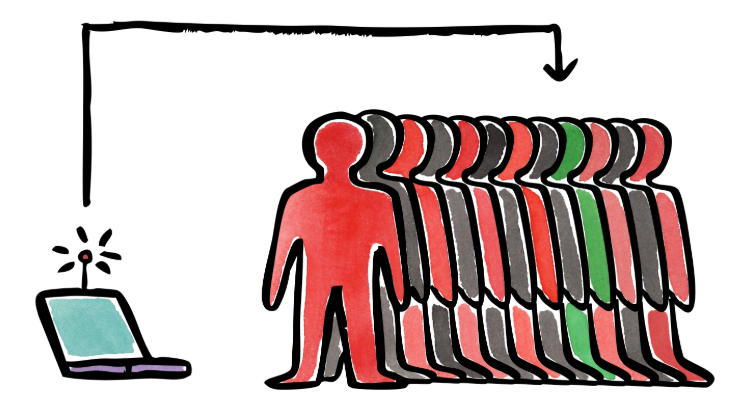
The interview debrief answers one question: should we move forward with this candidate?
When you're one of a three-person hiring team juggling a dozen open roles, you don't have time for hour-long debates that end with 'let's circle back Monday.’
While your hiring committee debates "culture fit," three competitors just made offers to your top candidate.
In a midsize company, every open role hurts. Think of your interview debrief process as a framework for high-velocity hiring, without cutting corners on candidate experience. Set your scoring, customize your template, and get everyone on the same page quickly.
Key takeaways
- A structured debrief process reduces bias and speeds up hiring decisions
- Interviewers should use scorecards immediately after each interview
- The recruiter is the facilitator, interviewers are contributors, and the hiring manager is the final decision maker
What is an interview debrief?
An interview debrief is a structured meeting where your hiring team reviews performance and shares feedback on interviewed candidates. The best debriefs happen immediately after interviews wrap, use standardized scorecards to compare candidates, and end with a decision to hire, reject, or advance to the next round.
“The debrief is not a vibe check,” says Tejal Rives, former Amazon employee and founder of The Frustrated Recruiter. “It’s supposed to be a structured process that takes the individual bias out of any one person’s gut feeling.”
Tejal focuses her debriefs around five core questions:
- Can this person do the job?
- Will we regret this if they get another offer while we’re still deciding?
- Will we feel bad if they reject our offer?
- Do they add to the team?
- Are they an a**hole?
The ideal candidate will be capable, enthusiastic, and (above all) easy to work with. Start with a clear debrief template to keep everyone on the same page.
Interview debrief template
Candidate: [Name]
Position: [Job Title]
Date: [Interview Date]
Facilitator: [Name]
Attendees:
- [Interviewer 1]
- [Interviewer 2]
- [Interviewer 3]
Must-have requirements:
- [Requirement 1]
- [Requirement 2]
- [Requirement 3]
Feedback
Interviewer 1: [Name]
- Rating: ☐ Very poor ☐ Poor ☐ Neutral ☐ Good ☐ Very good
- Key strengths:
- Concerns:
- Specific examples:
Interviewer 2: [Name]
- Rating: ☐ Very poor ☐ Poor ☐ Neutral ☐ Good ☐ Very good
- Key strengths:
- Concerns:
- Specific examples:
Interviewer 3: [Name]
- Rating: ☐ Very poor ☐ Poor ☐ Neutral ☐ Good ☐ Very good
- Key strengths:
- Concerns:
- Specific examples:
Discussion Notes:
[Focus on] conflicting signals]
Final decision:
☐ Extend offer – Next steps: [Action items, timeline]
☐ Reject – Reason: [Document for legal compliance]
☐ Advance to next round – What we're still assessing:
Decision by: [Hiring Manager Name]
Follow-up actions:
- [Action item, owner, and date]
- [Action item, owner, and date]
- [Action item, owner, and date]
8 best practices for interview debriefs that don’t waste anyone’s time
Hiring with no framework leads to wasted time and expensive mistakes. You want the candidate who has what it takes to do the job (not just the one who went to the same college as the founder).
The right debrief process fixes both issues: you move faster and hire better.
1. Set clear expectations before interviews start
Define who evaluates what before anyone meets a candidate.
Share the job req, interview questions, and scorecard in advance so everyone knows which competencies they're assessing and how to score them.
2. Require scorecards immediately
No scorecard, no vote. Interviewers must complete their evaluation within one hour of the interview, before they read anyone else's feedback.
Use a simple rating system tied directly to job requirements:
👍👍 Very Good = 10
👍 Good = 7.5
⭘ Neutral = 5
👎 Poor = 2.5
👎👎 Very Poor = 0
Instruct interviewers to leave their examples in the comment box.
Once each candidate has been scored, view them side-by-side to compare feedback. Send reminders to interviewers who haven’t submitted their scorecards.
3. Schedule the debrief for the same day
Treat the debrief like the most important meeting of the day. If same-day scheduling is possible, go for it. Aim for within 24 hours max to keep observations fresh.
The facilitator (usually the recruiter) opens by restating the role's must-have requirements. Then each interviewer shares their assessment, starting with the most junior person first to prevent senior voices from dominating.
Each person gets two minutes to share their rating, the evidence that supports it, and voice any concerns.
4. Focus discussion time on split decisions
If everyone voted Very Good, skip the debate and discuss offer terms. If everyone voted Poor, end the meeting and move on.
Focus 80% of your meeting time on areas where the team needs to work through conflicting signals.
Is Candidate A's deeper technical expertise more valuable than Candidate B's leadership experience? Make trade-offs explicit.
5. Push back on vague feedback
When someone says "something feels off," the facilitator should immediately ask: "What led you to that concern? What specifically did you observe?"
Focus on what the candidate said and did, not assumptions:
- Vague opinion: "I don't think they’re strategic enough."
- Facilitator pushback: "What specific response led to that conclusion?"
- Evidence-based response: "When asked how they prioritize their roadmap, they focused entirely on bug fixes and couldn't outline a quarterly goal."
Ask for direct comparisons: "You rated Candidate A higher on problem-solving than Candidate B. What evidence drove that difference?"
6. The hiring manager owns the final decision
End the meeting with a vote, or by updating your individual scorecards in your applicant tracking system (ATS) for a single combined score. The hiring manager makes the call, but if they override the panel's consensus, they need to be able to explain why with data and examples.
In the event of a tie-breaker, document which requirement tips the scale.
7. Let AI do the grunt work, not the deciding
Use your ATS to pull interview notes, compile scorecards, and line up candidates for comparison.
If you’re already using AI agents to automate your post-interview workflows, connect it directly to your ATS using the Model Context Protocol (MCP).
Use AI to handle the setup with prompts like: "Compare our three Product Manager finalists side by side" or "Draft rejection emails for the Marketing Coordinator candidates who didn't make the cut."
AI organizes, humans decide. Always.
8. Debrief candidates
The debrief should help you keep it focused.
- What stood out to you in this interview? What was your first impression?
- What do you think went well or not so well?
- Initial thoughts or questions you wish you would have asked?
- What’s the next step and are you looking forward to it?
Reach out to your top choice first with a verbal offer.
If they accept, send thoughtful rejection emails. Telling a candidate they didn't get the job is never easy. Acknowledge their strengths and thank them for their time. Attach a candidate experience survey to collect their feedback on how you can improve the process.
If your top choice declines, you can quickly pivot to a silver medalist, but only if you've kept that relationship warm.
Focus your hiring manager debrief to make each round sharper than the last
The hiring manager debrief isn't about rehashing individual candidates. It's about making sure your recruitment workflow is working.
Review pipeline health and velocity
Start by looking at the numbers. How many candidates entered each stage? Where are they dropping off? How long is each stage taking?
If you're seeing drop-off after the phone screen, your questions might be turning away qualified candidates. If time-to-hire is stretching past two weeks, look at ways to tighten your screening.
Identify gaps in the interview process
Did multiple interviewers ask the same questions? Did anyone assess communication skills? Were technical competencies covered thoroughly?
Use this time to spot overlap and fill gaps before the next round.
Calibrate scoring standards
Compare how different interviewers rated the same candidate. If one person consistently scores higher or lower than the rest, you've got a calibration problem.
Walk through specific examples as a group: "When you rated Sarah 'Strong Yes' on problem-solving, but gave Michael a 'No' on the same criteria, what evidence did you see that drove that difference?" Align expectations for future candidates.
Document what's working (and what's not)
Keep notes on questions and feedback from the hiring team. Track which evaluation criteria actually predicted success in the role.
Remember: recruiters and hiring managers are on the same side. Even the most unique and nuanced interview questions can't guarantee a consensus 100% of the time.
Your debrief, minus the drama
The difference between a 90-minute debate and a 15-minute decision is everyone walking into the room with the same evidence.
When your team uses structured scorecards, standardized questions, and clear decision criteria, your interview debrief becomes what it should be: a final checkpoint, not a starting point.
Breezy's Interview Analysis automatically reviews video interview transcripts and scores them against your criteria, so every round rolls up into one score right there on the candidate's profile. Your hiring team sees the same breakdown and makes faster decisions with confidence.
Build a repeatable, bias-reducing debrief process. Try Breezy free for 14 days
FAQs
Who should lead the interview debrief?
In most cases, the facilitator is the recruiter. Their job is to keep the conversation on track, push back on vague feedback, and make sure everyone's voice is heard; they don't override the hiring manager's final decision.
How long should an interview debrief take?
For clear-cut decisions on roles you’ve hired for in the past, 15-20 minutes should be enough. For split decisions where you need to discuss conflicting signals, plan for 20-30 minutes. If you're going over 30 minutes, look at updating your scorecards.
What if the team can't agree on a candidate?
Go back to the must-have requirements. Does the candidate meet the non-negotiables or not? If yes, dig into what's causing the split. Is it a real concern or personal preference? The hiring manager makes the final call based on clear and defensible evidence.